Peter Thomas Was a Marxist Intellectual With a Mission
· Jacobin
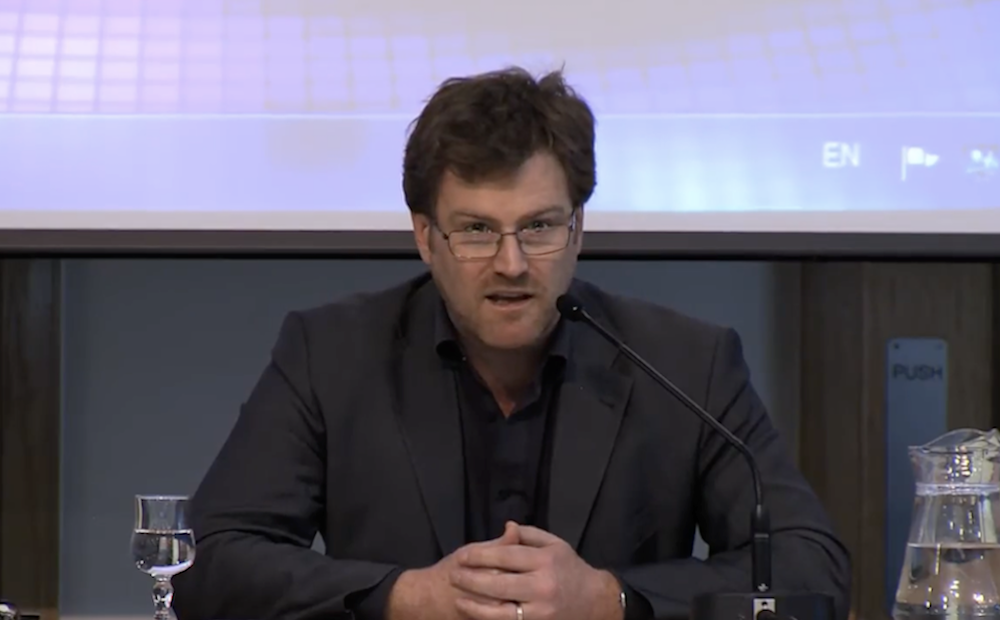
It is difficult to write in memory of Peter Thomas. Not for lack of memories, but because there are too many. So many discussions come to mind, shared projects, collective volumes to which we both contributed. One obvious one is In Marx’s Laboratory: Critical Interpretations of the Grundrisse (2013), which Peter coedited with Riccardo Bellofiore and Guido Starosta. But my thoughts turn even more insistently to The Government of Time: Theories of Plural Temporality in the Marxist Tradition (2017), coedited by Peter and Vittorio Morfino. The preparation of that volume was accompanied by countless discussions and meetings. I remember one in Milan, intellectually lively, friendly, and full of good humor. In those discussions, Peter had a remarkable ability to defuse tensions and soften the occasional sharp edges of disagreement without compromising the intellectual or political rigor of the exchange. He did so naturally, with a joke and a smile.But now other memories come flooding back. Peter, his family, his wife Sara, and their little girls. After I moved to California, it became more difficult for us to see each other and keep in touch. Yet only recently we had been in contact again, exchanging ideas and making plans for new projects. I had invited Peter to participate in a panel on my latest book, next month, at the Historical Materialism conference in London. He had gladly accepted and had already begun making plans for a dinner at his home. I still find it difficult to believe that I will not see him in London. I canceled the panel. It makes no sense to sit around discussing my book without Peter.A few months ago, I had also asked Peter to write a review essay for Political Theory, surveying the major publications and interpretive currents in Marx scholarship over the past twenty years. Peter had agreed, asking only for a little more time because he was overwhelmed with academic commitments. For five years, if I remember correctly, he had been serving as head of department in Brunel’s Department of Social and Political Sciences.I can’t help thinking: damn academic administration. Increasingly, it has become a machine that devours academics’ time, giving them in return stress, conflicts of every imaginable kind, and personality clashes that multiply in direct proportion to the loss of any intellectual meaning in academic work. Peter wanted to do research. He wanted to go on learning. He was a Gramscian who wanted to build a Marxist cultural hegemony. For him, Historical Materialism was precisely such a laboratory. That is why its growth mattered so much to him. It was not, and is not, simply a matter of numbers. It is about establishing and asserting a presence, developing a network of intellectual and political relationships. Peter once told me this himself.Peter believed in the political mission of the intellectual. At the heart of his intellectual project was a sustained effort to rethink the Gramscian concept of hegemony. Already in The Gramscian Moment (2009), Peter reconstructed hegemony as a central concept of Marxist political theory, inseparable from the formation of collective political capacities and the struggle for emancipation. His last book, Radical Politics: On the Causes of Contemporary Emancipation (2023), further developed this project, offering a powerful rethinking of politics beyond the alternatives of technocratic governance and populism.Hegemony, in this perspective, is not simply a form of domination secured through consent but a way of doing politics through which subordinated groups develop their capacities for collective action and self-government. It is a pedagogical practice, but not in the sense of intellectuals educating passive masses. After all, who educates the educators? Rather, political actors learn through collective experimentation, confrontation, organization, and the transformation of their own practices. This conception does not reject political leadership in the abstract. Rather, it understands leadership not as a power possessed by an individual or organization but as a relationship constituted and continually transformed through collective political activity. Leadership itself is transformed as that activity develops.“Protests without political direction are expressions of anger bordering on nihilism. Political leadership without the masses is empty vanguardist voluntarism. Intellectual work without concrete ties to politics and the anger of the masses is academic onanism.” This is how, many years ago, in a conversation with Peter in Padua, I summed up the agenda for the work that lay ahead. We never had the opportunity to return to that agenda, and I do not know how Peter might have reformulated it in light of the present.Looking back, however, I realize how much of this understanding of hegemony was already present in Peter’s own intellectual and political activity. His commitment to Historical Materialism, his efforts to bring together scholars from different countries and traditions, his generosity toward comrades: these were not simply expressions of an admirable personality. They were also part of a particular way of understanding intellectual work as political practice.I remember what struck me when I first met Peter. It was 2004 or 2005. Peter began telling me about his life in Naples, his research on Antonio Gramsci, and his connections with Neapolitan intellectuals and comrades. At the time, Peter, like so many of us, was a young scholar in a precarious position, moving around Europe. I was a few years older and had just secured a research position in Padua. Peter was traveling the length and breadth of Italy, seeking to build and consolidate a network of intellectual and political relationships. He was not simply going around meeting people. He was engaged in an intellectual and political project. Yet there was nothing instrumental about what he did. Quite the contrary: Peter did not ask for favors. He invited others to take part in a larger intellectual and political project. We discussed his approach to building such a project at length. I understood his point of view, but at the time I found it too ecumenical. Having been schooled in Amadeo Bordiga’s tradition, I believed we needed to be more selective. Better a few people, but the right ones.Peter helped me and other young Italian scholars break out of our provincial intellectual confines. In 2004, he encouraged me to participate in the Historical Materialism conference in London. My intellectual formation, shaped in Italy and Germany, had decidedly neglected the English language. To put it bluntly, my English was terrible. I told Peter as much. He smiled and replied, “Who gives a shit?” If this Australian cafone could speak Italian, he said, then surely you, Max, could speak English. I let myself be persuaded and went to London to present a paper on Walter Benjamin and violence. It was November 2005.With Peter’s help, I encouraged other Italian comrades to participate in Historical Materialism. For several years, a group of young researchers from Padua became regulars at the conference. Some of our publications were translated into English and published by Brill. Peter and Sara translated my book on Karl Marx and the layers of time, which they persuaded me to title Marx’s Temporalities. I was not the only one to publish with Brill. I remember Luca Basso, Vittorio Morfino, and Riccardo Bellofiore. Others deserve to be mentioned as well. What matters is that Peter helped us move beyond our provincial horizons, reach a wider audience, and make ourselves understood by anglophone readers. If that last task has not always been accomplished, the fault certainly does not lie with Peter.He helped us become part of a larger conversation, part of a larger network, and part of a hegemonic project.Did we succeed? Did we fail? These are the wrong questions, and there can be no right answers to the wrong questions. Hegemony, as Peter understood it, was not an achievement to be measured once and for all, but an ongoing practice of collective intellectual and political work. For those of us who had the good fortune to know Peter, to work with him, and to call him a comrade, keeping his memory alive means keeping that political project in motion. And, for those who can, it also means being there for his family.If I am now writing these lines from Santa Cruz, where I hold a position at the University of California, Peter played a part in making that possible. He encouraged me to venture into the anglophone world. He helped me break free from the provincialism of the Padua jargon, whose very essence he had grasped and loved to make fun of.That irony of his, and his generosity of spirit. How much I miss it, and how much I will go on missing it.This article originally appeared in Jacobin, a democratic socialist magazine publishing long-form essays and analysis on politics, economics, and culture. Subscribe to the print edition for $20 a year.
Visit bettingx.club for more information.