1956 Was a Missed Opportunity for Socialist Reform in Poland
· Jacobin
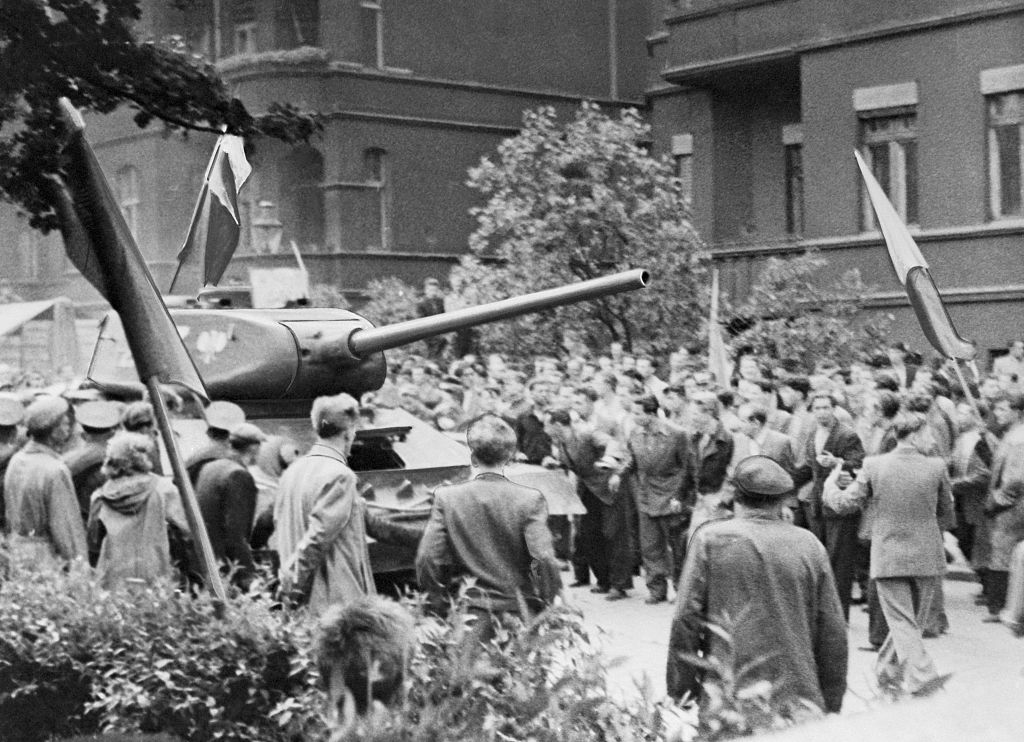
In June 1956, a delegation of renowned British left-wing economists, including Joan Robinson and Maurice Dobb, traveled to Poland to learn about its socialist transformation. The newly installed socialist government had driven through a program of economic modernization, as the country industrialized and urbanized, and free universal health care and education were being provided for the first time.While visiting the city of Poznań, they expected to admire the material achievements of the new Polish People’s Republic (PRL). Instead they witnessed Polish soldiers manning Soviet tanks as they put down a workers’ revolt. Living standards had not kept up with industrial expansion, and a wave of strikes and demonstrations broke out.Government repression left an estimated fifty-seven people dead — the largest single such action in the PRL’s history. The delegation left with many of its illusions shattered, as Poland sank deeper into an existential political crisis.The Opening of ReformA period of liberalization had preceded the events of 1956. Joseph Stalin’s death in 1953 enlarged the space for political and economic reform in Eastern Europe, and the end of the Korean War the same year eased Cold War tensions. Room opened for alternative socialist economic paths: the USSR developed friendlier relations with Yugoslavia, whose leaders had broken with Stalin in 1948, and Hungary halted collectivization.Pressure for reform built within the ruling Polish United Workers’ Party (PZPR), as reformers sought greater economic and political decentralization. Critical voices grew louder in the press, especially about economic inefficiencies, bureaucratic mismanagement, wasted resources, and stagnating living standards.A current of alternative Marxist economic thinking took center stage. Grouped around two world-renowned economists, Michał Kalecki and Oskar Lange, it developed somewhat competing reform programs.Poland faced problems common to all twentieth-century transitions to socialism. Building socialism in a poor, semifeudal country devastated by Nazi occupation and war proved no easy task. Initial heavy industrialization brought impressive results (rapid urbanization, economic growth, and the expansion of welfare), yet the overemphasis on heavy industry and neglect of services and consumption fueled working-class discontent.Kalecki proposed rebalancing the economy through prioritizing investment in sectors that would directly improve the living standards of the population. Lange (and his collaborators, including Włodzimierz Brus and Tadeusz Kowalik) drew inspiration from Yugoslavia’s decentralized model of workers’ councils and workplace self-management.Behind these debates lay a growing realization that socialism could not be created rapidly through government decrees. It was a long historical process in which features of the past (markets, money, private property) would persist for some time.Workers Rise, Leaders ShiftBy the mid-1950s, pressure from below had spread across the socialist bloc, with strikes and demonstrations in Czechoslovakia, East Germany, and, most notably, Hungary. The June events in Poznań sparked a wave of protests throughout Poland, as workers demanded higher wages and better conditions. Workers’ councils sprang up across the country, as employees sought participation in management, the decentralization of decision-making, and a reduction of the bureaucracy’s power.These protests unfolded against a backdrop of change at the top. In December 1954, Władysław Gomułka was freed after spending four years in prison. Gomułka had led postwar Poland until 1948, when Stalin accused him of nationalist deviations. After his release, he advocated an alternative “Polish road to socialism,” distinct from the Soviet model.Reformist pressure intensified after the PZPR took the unique step in the Eastern Bloc of circulating Nikita Khrushchev’s “secret speech,” which had been delivered at the Twentieth Congress of the Communist Party of the Soviet Union on February 25, 1956, among its party members. Gomułka was reinstated to the Politburo, becoming the unifying figure for opposition currents within the party.However, his call for a distinct form of Polish socialism and demands to remove Soviet officers and advisers from the Polish armed forces, security apparatus, and Politburo brought him into direct conflict with Moscow.The October ShowdownOn October 19, 1956, the day the Eighth Plenum of the Central Committee of the Polish United Workers’ Party was due to start, a Soviet delegation, including Khrushchev, landed unannounced in Warsaw, seeking to halt Gomułka’s reforms. Talks ensued as news spread that Soviet troops were heading toward the Polish border. Sections of the Polish army and groups of workers prepared to defend the capital. The Soviets departed with no agreement and left their troops stationed a hundred kilometers from Warsaw. Military intervention seemed imminent.Once back in Moscow, however, Khrushchev learned that the Communist Party of China opposed any intervention in Poland. The Chinese urged the Soviets to accommodate Polish demands and recognize Gomułka as general secretary. Beijing wished to maintain some semblance of pluralism within the socialist camp, viewing Poland — given its size and geographical location — as an essential counterweight to Moscow in Eastern Europe.The Soviets backed down and conceded that Poland could now chart its own course, avoiding the fate of Hungary, where Soviet forces crushed the uprising in Budapest the following month. Crowds poured onto the streets of Warsaw, celebrating a huge national victory.Gomułka (now installed as general secretary) addressed a rally of up to one million people in front of the Palace of Culture, and, for a moment, the PZPR leadership enjoyed widespread popular support. The events of October 1956 in Poland (which became known as the “Polish October”) marked the moment when socialism in Poland found its own voice, resonating with the wishes of broad layers of the working class and society.A Brief ThawA period of political liberalization opened. The government released thousands of political prisoners and signed an agreement with the Catholic Church after releasing Cardinal Stefan Wyszyński from prison. Crucially, it halted the collectivization of land, leaving most agriculture in private hands. The relative autonomy of the Catholic Church, the existence of millions of small private farms, and the functioning of some private businesses remained distinctive features of Polish socialism in Eastern Europe.The events of 1956 also cemented an alliance between parts of the intelligentsia and sections of the working class. Workers’ demands for enterprise autonomy and self-management aligned with the views of reformist economists. At the government’s request, the previously marginalized economists, led by Kalecki, drew up proposals for workers’ councils, enterprise autonomy, and profit-sharing.Parliament established an “Economic Council at the Council of Ministers” (led by Lange) to reform planning and management. For a short period, Kalecki, Lange, Brus, and others directly guided Poland’s economic reforms.However, this window soon closed. Most of the economic council’s recommendations were ignored or later reversed. The party leadership reasserted political control and redirected policy toward orthodox centralized planning, once again prioritizing heavy industry.The party leadership, with Gomułka now in charge, had paid lip service to workers’ democracy and enterprise autonomy, understanding the wide popularity of these policies while having no real intention of implementing them. Within little more than a decade, the main dissenting voices had been expelled, and many were forced into exile during the purges of March 1968.Lessons of 1956A fascinating feature of 1956 was the alliance that formed between sections of the working class and the socialist intelligentsia, both of which had grown in size and stature during the first postwar decade. Workers went beyond economic demands for improved living standards, seeking greater participation in and control of production. For a short time, the theoretical insights of the intelligentsia directly aligned with the practical demands of workers in Poland’s new industrial centres. At the height of the uprising, workers even surrounded Oskar Lange’s home, fearing he might be arrested.The events of 1956 are a reminder of both the necessity and the limits of state-planned industrialization. Heavy industrialization triggered an unprecedented civilizational leap forward in Poland whose benefits are still felt today. Yet, as elsewhere in the socialist bloc, this path met structural and social limits, not least shortages of consumer goods and the underdevelopment of services and light industries.Lange and Brus sought solutions through decentralization, market mechanisms, incentives, and workers’ participation, aiming for balance within the socialist economy. They tried to align Marxism with neoclassical economics, believing socialism could outperform modern capitalism, where monopolies had distorted markets.Kalecki, meanwhile, recognized that socialism could only succeed if the state retained the support and participation of the working class. For him, while the key economic distinction of socialism was the state’s power to direct investment, this had to be done in a way that guaranteed steady improvements in living standards. He was more skeptical of the Yugoslav model, fearing that strong workers’ councils would reduce employment to maximize profit shares for those already employed.From 1956 to 1981 and BeyondThese debates once again leapt from the pages to take on practical importance during the momentous Solidarity trade union strikes in 1980. When striking workers at the Gdańsk shipyard occupied their workplace, they combined demands for higher living standards with calls for independent trade unions and expanded workers’ control in the workplace.Tadeusz Kowalik (who cooperated with both Kalecki and Lange) initiated a delegation of “experts” to travel to the shipyards to advise the strikers, recognizing the spirit of 1956 there. However, after Solidarity had been decisively defeated and atomized by the declaration of martial law in the 1980s, the remnants of the PZPR and Solidarity movement introduced a series of neoliberal reforms as Poland transitioned to capitalism.Even during the round-table negotiations in 1989, both sides of the political divide still declared their formal support for enterprise democracy and workers’ councils. But the great industrial enterprises that had been built under the PRL did not pass into workers’ hands after its demise. Instead, they were either privatized or shut down.Whether the ideas that grew in Poznań and flourished in Gdańsk will ever find a new political home remains an open question. Seventy years after the momentous events of 1956, their relevance has not diminished with time.This article originally appeared in Jacobin, a democratic socialist magazine publishing long-form essays and analysis on politics, economics, and culture. Subscribe to the print edition for $20 a year.
Visit likesport.biz for more information.