Lula’s Surprise Victory Is a Beam of Hope in a Dark World
· Jacobin
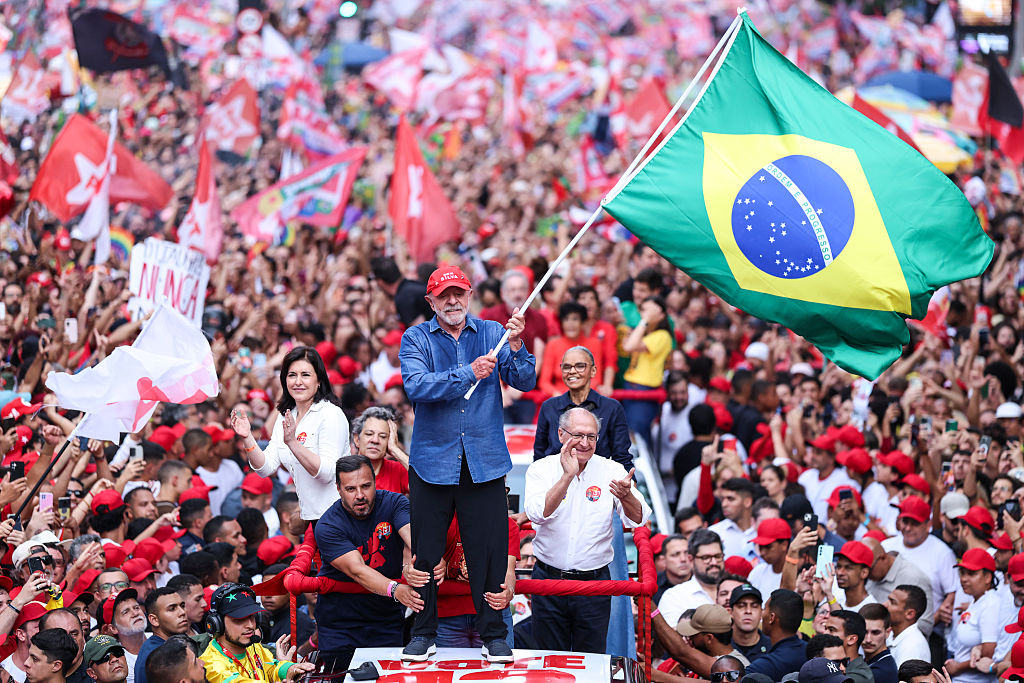
Following a stunning, inspiring turnaround driven by mass mobilization of the Brazilian people, Luiz Inácio Lula da Silva has won his fourth presidential election. This achievement marks an unprecedented shift in Brazilian political history: never before has a candidate who trailed in the first round managed to come back and win.The election — which pitted Lula against Flávio Bolsonaro, son of former president Jair Bolsonaro, who is currently imprisoned for an attempted coup d’état following his defeat in the 2022 elections — was marked by obscene interference from the Trump administration, with Big Tech companies like Meta acting shamelessly in favor of the far right. All this in a context where other interventions in the region by Trump were successful, leading to the election of far-right presidents — most notably in Colombia — which created the sense of an invincible Trumpist wave across Latin America.Defeated by about two million votes on October 4, Lula gained more than ten million new votes on October 25, while Flávio Bolsonaro received just over three and a half million more than in the first round. Lula increased his vote share in virtually every Brazilian municipality after having been written off just three weeks ago. What changed in such a short time provides a lesson for socialists the world over.How a Victory Is BuiltWhile pro-Lula demonstrations began immediately after the defeat in the first round, driven largely by student organizations, the Workers’ Party campaign sought to connect with a new generation on the left wing. At the same time, it triggered a genuine earthquake in the party’s communication strategy, brought about by the arrival of Congressman André Janones, recently reelected as a candidate for the center-left party Rede.Lula, who is eighty, invited an entirely new generation of newly elected congresspeople to Brasília immediately following the first round of voting. Despite the growth of the far right at the expense of the traditional right and center in the legislative elections, held concurrently with the first round of the presidential race, the Left made gains in the National Congress, bringing in young figures who are adept at social media and communication and who brought fresh energy to the campaign.Among these rising stars are twenty-one-year-old representative Ana Elisa — hailing from Minas Gerais, Brazil’s quintessential swing state; Erika Hilton, a trans woman reelected with a record number of votes; Jones Manoel, a communist from Pernambuco (Lula’s home state); and Guilherme Cortez, a representative who identifies as a twink. They all represent a generation of young people with millions of Gen Z fans in Brazil; they are social media stars, despite the platform algorithms favoring right-wing content.But the campaign’s most notable figure was forty-two-year-old Janones, who created a WhatsApp group dubbed Exército de Lula (Lula’s Army) that grew to over ten million followers, through which he carried out organized and disciplined agitation and propaganda. Nearly one in every ten Brazilian voters joined a single group in just three weeks. Janones is often snubbed by the old intellectual left-wing elite, yet he has always been popular with the masses. Now he has become a true celebrity.Working from the assumption that Meta’s algorithm was biased against the Left, Janones orchestrated major social media campaigns, such as encouraging Lula’s supporters to post Instagram photos of themselves wearing the Brazilian national soccer team jersey, a garment once a symbol of unity but subsequently co-opted by the far right. This action was joined by countless Lula supporters and made a major splash on social media one day before the failed demonstration organized by Flávio Bolsonaro on Avenida Paulista, a vital hub in the city of São Paulo.The strategy was a success, with Janones playfully repurposing the far right’s military vocabulary, referring to his followers in Lula’s Army as “soldiers.” Beyond the algorithms, this move by Janones subverted the semiotics of recent years, during which the Bolsonaro family mobilized its vast base using military terminology — a natural enough approach, given that Bolsonaro and many of his key behind-the-scenes figures are or once were military men.The Brazilian Far Right Cornered for the First TimeEven after its defeat in 2022, the far right remained a powerful force on social media, driven by a combination of effective communication and preferential treatment by the platforms’ parent companies. During the Lula administration, posts by pro-Bolsonaro Congressman Nikolas Ferreira garnered higher engagement than those of global pop stars. This was used to wage a dirty yet highly effective opposition campaign against the third Lula administration.While Lula appeared mired in a series of political missteps upon his heroic return to the presidency in 2022, leading a complex Broad Front coalition, his opponents seemed unbeatable on social media and effectively connected with the Brazilian people. Obviously, the criticisms from the far right had little to do with the problems facing Lula’s third administration; rather, Bolsonaro allies leveraged the government’s relative unpopularity to advance their own agenda of dismantling Brazilian democracy.After defeating Bolsonaro in 2022, a victory that echoed his own political comeback from his time as president in the 2000s, Lula seemed trapped in a Groundhog Day scenario, where every government crisis was amplified by mass agitation from the far right. Curiously, this state of stagnation only came to an end in the last three weeks. Janones’s strategy brought fresh air, pulling millions of activists out of a potentially deadly depression, given the imminent return of fascism, as veteran journalist Luiz Carlos Azenha stated. Janones’s insane twenty-four-hour live stream before the elections was preceded by a live stream with millions of views featuring testimonials from many Brazilian artists, showcasing perhaps the very best of Lula and Brazil. From that point on, the Right lost its comfortable monopoly on communication.Lula has once again reached the masses, for the first time since returning to the presidency. But this fourth term must entail governing in a different way. It will require an approach closer to his first two terms, in which Lula was able to set the terms of debate within the country, yet with a need for more intensive dialogue and action with the masses of Brazilians who delivered this election for him. All of this is taking place in a world that is, quite literally, on fire. The economy will be a problem, and Lula will have to confront a bourgeoisie that desires a more savage capitalism than anything seen before, even in Brazil.For those who saw Flávio Bolsonaro acting as if he were already president on October 25, Lula’s surprise victory was a historic relief. For those who have lived through the last few weeks in Brazil — attending massive demonstrations, unprecedented in the country’s electoral history, and growing furious at every debate between Lula and Flávio, as well as at the cruel and boundless arrogance of the right-wing leader — the operative word is, finally, hope.This article originally appeared in Jacobin, a democratic socialist magazine publishing long-form essays and analysis on politics, economics, and culture. Subscribe to the print edition for $20 a year.
Visit freshyourfeel.org for more information.