France’s Rulers Want Violence as a Pretext for a Crackdown
· Jacobin
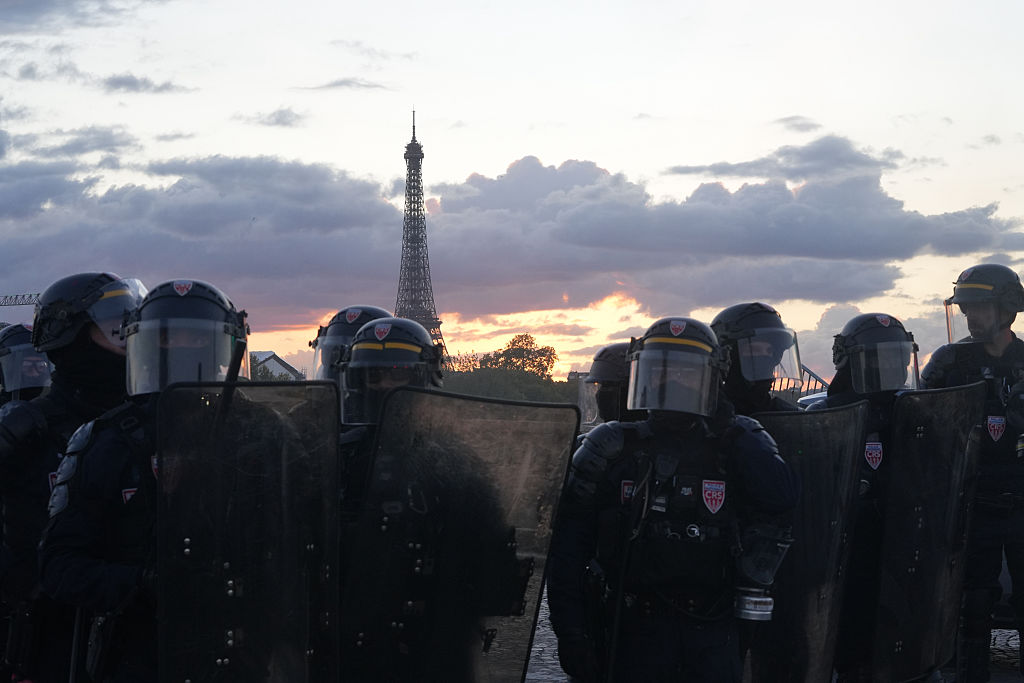
The French government was almost desperate for something to happen.Over the weekend, the social movement that started with a series of high school blockades in mid-September continued with a well-attended, orderly march around the outskirts of Paris.The protest route, initially scheduled and approved to take place between the central Place de la Bastille and Place de la Nation, was shifted to a path between Porte d’Italie and Porte de Vincennes, a route along the southeastern rim of the city that traces the highway that encircles Paris.The modified route for October 24 took around 110,000 marchers away from the center of Paris, where, the previous weekend, impressive scenes of mobilization at symbolic locales like Bastille and Les Invalides had demonstrated the expansion of the social movement. At least half a million people had already marched on October 17 across France, brandishing slogans demonstrating against the high cost of living, the fuel price crisis, and the rise of the far right, as well as in support of the demands of France’s high schoolers.In the evening of October 17, violent confrontations between the police and some protesters had accelerated, and the police appeared to lose control of the streets. Hundreds of businesses were looted and burned in Paris by a combination of black bloc and autonomist militants as well as opportunistic vandals.In the lead-up to this Saturday’s march, a steady drumbeat of condemnation came from the world’s governments and ruling class. A wave of racist bile swept from the White House across the governments of Europe, grotesquely laying the blame for every instance of looting or vandalism on France’s Arab and African population. Ignored, or condescended to, were millions of people’s demands to improve conditions in high schools; to avoid another budget with over €50 billion worth of cuts and the steady chipping away of the country’s social system; or to address the multiplication of crises facing the country.Instead the government fretted nervously about the potential for more violence on October 24, establishing days-long curfews from 11 p.m. to 6 a.m. across multiple big cities and mobilizing ten thousand additional police officers.Sébastien Lecornu, the prime minister, even met with the directors of some of France’s largest telecoms firms to prepare them to cut off access to social media like TikTok, Instagram, Snapchat, and Twitter.“If I give the instruction, proceed without delay to temporarily suspend the concerned services for a duration of a few hours,” Lecornu wrote to the companies.The government’s anticipation that October 24 would inevitably degrade into the same chaos of the week before echoed its line since the student movement began. France’s leadership believes that so-called far left forces like France Insoumise are orchestrating the aboveground movement to create conditions of chaos that their proxies in the “ultraleft,” which include a variety of autonomist and anarchist movements like black bloc, can exploit to topple the government.“There was a plan in place organized by small, far-left groupings, encouraged from the National Assembly by France Insoumise. . . . to destabilize the Republic, to bring down the government, . . . [the] state that protects honest people, which allows you to go shop for groceries on Saturday,” fulminated Laurent Marcangeli ahead of Saturday’s march. Marcangeli, an MP from Corsica, is the president of the centrist party Horizons, founded as a vehicle for Édouard Philippe, President Emmanuel Macron’s first prime minister and currently the leading (though sinking) contender to represent the right and center in next year’s presidential election.France Insoumise, Marcangeli claimed, is nothing more than the legal branch of this “galaxy” of ultraleft organizations, and its leader, Jean-Luc Mélenchon, has an insurrectionary attitude that could lead the country toward civil war.Marcangeli also called for France Insoumise to fund the repairs for the damage caused by the rioting. Claiming that the party stands by the rioters, he pointed to the €4 million that France Insoumise’s elected officials receive in public money, saying that it came from “our taxes.”Potential EnergyAs it turned out, October 24 stayed largely calm, though there were some confrontations between police and protesters at Paris’s Place de la Nation, which the police kept cordoned off tightly. Around 6 p.m. I was in the area and tried to see what was going on down a street filled with tear gas and booms, but was pushed away gently but firmly by four shouting police officers.After stepping into a café just around the corner, I saw dramatic images of protesters facing off against police officers and tear gas on the television.They were showing the street I had been on just a minute before, but their video feed made the street look like there was a lot less light than I could clearly see from my view outside the café window.Earlier in the day in the crowd by Porte de Vincennes, Philippe, a sixty-six-year-old Parisian, told me that the images being commented on around the world were basically just “goddamn propaganda.””It’s politicians who benefit from this,” Philippe said, “in particular far-right politicians who can say voilà, France is going badly because of immigrants. But it’s not immigrants, it’s French people [who are protesting].”The propaganda is spread by social media and the TV, he says, because people who “want power” want it.“It’s bulls–t, it’s television, it’s the media who show all these images of brawling in the streets, but meanwhile very few people actually participate [in it,]” Philippe said. “I protested [last week] and I didn’t see a single [riot cop] where I was.”Throughout the day, mainstream media fed the flames with speculation about what might happen after the sun went down. They stuck to this story even as masses of people flowed peacefully across bridges and over the tram tracks along the route, unmoved by the steady rainfall or the constant muted drone of low-flying helicopters hovering watchfully in the skies above.CNEWS, the reactionary cable news network owned by the pro–Marine Le Pen billionaire Vincent Bolloré, even broadcast a video of protesters pulling on masks next to footage of sturdy rows of riot police, predicting that this signaled an imminent outbreak of violence.“These protesters are changing their clothes,” CNEWS journalist Olivier Benkemoun commented as the camera ranged over a scene of upbeat demonstrators. “That’s significant. You’re in a protest march and suddenly you have people acting like future vandals, like future rioters.”“They’re equipping themselves,” he added breathlessly, sounding shocked. ”You’re seeing it live — helmets, balaclavas, masks. . . . it’s happening right beneath the eyes of the camera.”Within twenty minutes, Benkemoun offered a correction live on air. The footage wasn’t from Paris, but from Tirana in Albania, easily identified by a distinctive mural near the country’s Ministry of Education, Sport, and Youth.“That wasn’t Paris,” Benkemoun said. “I’d like to apologize on behalf of the editorial staff because the images of those people wearing masks came from Albania.”Did it matter though?“That doesn’t change anything,” the presenter chimed in response.“It’s the same technique,” Benkemoun agreed.Presidential ElectionsWhen I asked Philippe why he thinks this social movement in particular appears to be significant, he said it was because we’re in the lead-up to an election year.Next spring’s presidential election is never far from the surface in any discussion about the protests.After the October 17 march and rioting, Marine Le Pen and her party, Rassemblement National, leaped gleefully at the opportunity to present themselves as the party of order.Le Pen quickly filmed a stern, authoritative speech from behind a large, serious desk where she talked about the measures a Rassemblement National government would take against rioters.“We embody a peaceful France and an orderly France in the face of left-wing extremists,” Rassemblement National deputy Julien Odoul said at the party congress in Orléans, which also began on Saturday.In the meantime, the French government went into overdrive attacking France Insoumise for its alleged role in the violence.Despite its clear support for the high schoolers’ protest movement from the beginning, it’s unclear how exactly France Insoumise was connected to the violence. The government’s narrative rests on leaked intelligence reports from early on in the movement, claiming that the high schoolers were being coordinated by France Insoumise and their “proxies” in the “ultraleft.” Intelligence officers involved in those assessments later told investigative outlet Mediapart that they felt pressured by higher-ups to produce evidence of the link.Ahead of the October 24 march, Macron announced that requests to protest “by people without any legitimacy would be banned.”It was a clear message that the “ultraleft” groups who the government has blamed for the violence would be cracked down on with extreme force. But it’s also part of an escalating crackdown against France Insoumise, who are being linked more and more explicitly with the so-called ultraleft, despite clear strategic differences and even goals between this nebulous designation and France Inoumise.“Its importance is overestimated,” the political scientist Arthur Pouliquen told Le Monde in an analysis published over the weekend.“Those who share our struggle have no business being involved in looting and ransacking,” Mélenchon said after October 17, insisting on the movement’s nonviolent character. “We must refuse to participate in actions which have no political significance and which are contrary to our methods.”Nevertheless, the Le Monde analysis highlighted some links, calling France Insoumise the “umbrella” for both the “far left” and the “ultraleft.”Le Monde clarified that the party is neither of these things, but that they enjoy “harmonious” relations with the far-left camp, in the words of Frustration Magazine editor-in-chief Nicolas Framont.”In an extremely polarized political landscape, [France Insoumise] plays the role of an “umbrella” party for this political camp, often acting as the de facto representative of the antiestablishment,” Le Monde concludes.The idea that France Insoumise is merely the legal arm of an insurrectionary, prerevolutionary or now close-to-revolutionary left has gained currency on the center and the right in the week since the violence on October 17. More than one powerful member of the government has raised the idea of banning them all together.The latest to raise the question was the president of France’s Senate, Gérard Larcher, who’s second in line to the presidency.“Beware to those who seek insurrection,” Larcher told Le Figaro on October 19. France Insoumise “has been stoking the flames. . . . they bear a large part of the responsibility for this hateful discourse, the question of [banning them] can be posed.”This article originally appeared in Jacobin, a democratic socialist magazine publishing long-form essays and analysis on politics, economics, and culture. Subscribe to the print edition for $20 a year.
Visit newssport.cv for more information.