Is Radicalism the Answer?
· The Atlantic
Subscribe here: Apple Podcasts | Spotify | YouTube
Visit mchezo.life for more information.
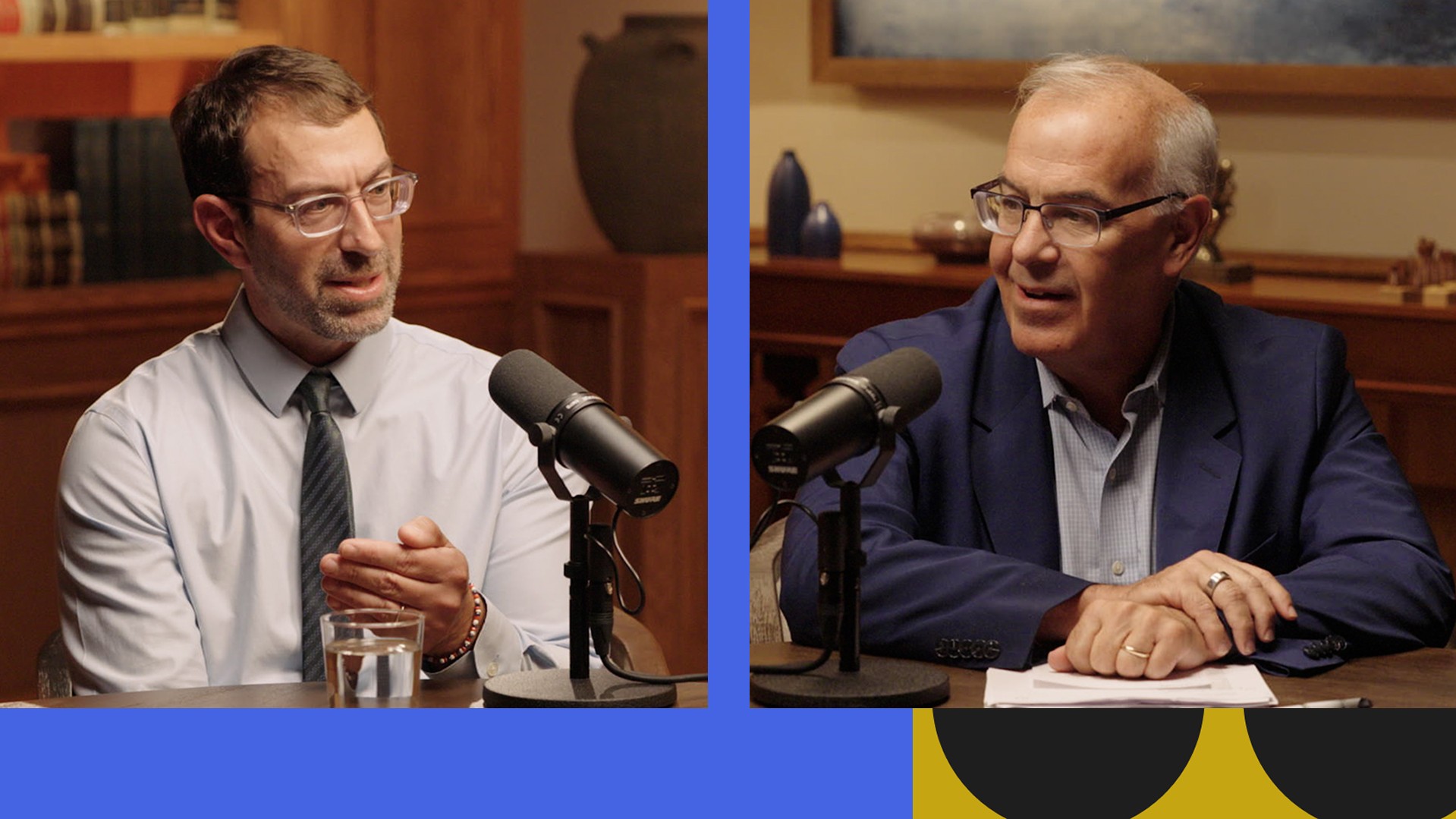
As we enter the midterm elections, Americans seem ready to move on from the Trump era, but there remains great disagreement about what should come next and how we might achieve it. The intellectual historian and law professor Samuel Moyn is among those who believe that liberals have become too timid about driving social, political, and economic change. If the Trump era was in part a response to the failures of centrist moderation, as Moyn suggests, then we may need something more radical to get us out of it. David Brooks is one of those centrist moderates, chastened by the many examples when radical change has led to tragic outcomes—including the example of Donald Trump himself. In this week’s episode, David and Moyn discuss emancipation, fallibility, and the disagreement beneath the disagreement.
The following is a transcript of the episode:
David Brooks: People are fed up. They’re sick of the establishment and the people who’ve been running things. They want change, and they want change now. When people like me are in the middle of this kind of emotional climate, all our alarm bells start going off.
We’re all the product of our times, and I grew up in the age of the Cold War. It was an age when all sorts of exhilarating beginnings led to blood-drenched culminations. The lesson I drew from all this is that moving fast and breaking things is not the way to go.
I became suspicious of people who wanted to burn everything to the ground and start over. I became, in other words, a moderate—the kind of guy who favors constant but incremental reform.
But let’s face it, the moderates of the center right and the center left have not exactly produced heaven on Earth. Instead, problems ranging from climate change, inequality, the federal debt have just festered. So maybe something more radical is needed.
That’s why I’m eager to talk to Sam Moyn. Sam teaches at the law school here at Yale, but in his heart, he’s an intellectual historian. He writes and thinks about the ideas behind our politics.
Sam and I are both liberals. We’re both members of the intellectual tradition that values democracy, individual freedom, and the free exchange of ideas. We oppose the authoritarianism that seems to be creeping in from both right and left. But Sam and I are different flavors of liberals. I’m the more moderate kind, chastened by the scars of history, cautious about instant radical change, and more inclined to steady reform.
I’m curious to know which of us is right about the current moment. Is it me, the incrementalist? Or is it Sam, who’s a little more transformational? That’s why I’m pleased to welcome Sam Moyn to The Permanent Questions.
Samuel Moyn: Thanks for having me.
Brooks: Oh, it’s a pleasure. I’ve been reminding people that you and I are both liberals. We both share the same broad philosophy, but I think we have different flavors of liberalism, and I want to get into that. I thought I’d spend a few minutes just describing where my world comes from, and then I’m going to ask you where your world comes from.
I was a Democratic Socialist in college. I was a revolutionary. I would’ve been with Bernie and Zohran and all those people. And I was assigned a book called Reflections on the Revolution in France by this guy Edmund Burke.
And he was like, “The world’s really complicated. You should be careful about what you think you can change, and therefore move incrementally—gradually, slowly, constantly, but incrementally.”
I hated that book, and I wrote up a whole bunch of papers of what an idiot this guy Edmund Burke was. So then I go out in the world and I work on the South and West Side of Chicago as a journalist, and two of the places I covered are housing projects called Cabrini-Green and the Robert Taylor Homes.
They were designed by planners and University of Chicago sociologists. They tore down the old neighborhoods, they put up these high-rises, and they didn’t bother to talk to the people in the neighborhoods.
When they tore down what they thought were rickety old buildings, they tore out the systems of social support the neighbors had built for themselves. By the time I got there, they were hellscapes. Crime, gangs had taken over. They’d made life worse for the people in those neighborhoods. And I’m like, “Holy crap, that guy Edmund Burke, he might’ve been right.”
Conservatism in the Burkean sense—or, as I would call it for the sake of our conversation, “moderation”—is basically based on two ideas in my view. One is that social change is really hard, and you could be wrong. Therefore, you should move incrementally so you can adjust.
So I go off into my journalism career, and one of the best things I ever covered in my life was the end of the Soviet Union. And I’m there one day in Moscow, and Boris Yeltsin, who was the democratically elected president of Russia, this old Soviet regime, as a last-gasp effort to stay alive, staged a coup.
All these tanks rolled into Moscow. And I interviewed a woman in that crowd, a 93-year-old lady named Valentina Kosieva, and I asked her about her life. She’d nearly been executed by the Reds in the civil war after the revolution in 1917. Every bad thing that happened in Soviet history happened to her.
And then the final story I’ll tell is I was covering the Middle East about the same time in mid-’90s, and I’m at the home of Shimon Peres, who was prime minister then. And it was a big celebratory dinner with about 50 or 60 people, and I’d say 40 percent of them were Palestinian negotiators on the Oslo Peace Process, 40 percent of them were Israeli negotiators, and the other 20 percent were people like me— pundits and scholars.
The atmosphere in that room was so warm because these men, mostly men, had been through years of negotiation, and they thought they had crossed the line, and we were gonna have a two-state solution. We were gonna have peace. It was a time people forget: If you lived in Gaza, you could fly on a Palestinian airline to a Palestinian airport holding a Palestinian passport.
We were on our way to nationhood, and Yasser Arafat vetoed the deal. And in the ensuing years, the moderates who were doing the Oslo Peace Process got displaced by extremists of both the Israeli side, the thugs who are settlers, and then the Hamas thugs. And basically, theocratic fascism took over on both sides.
And so these experiences confirmed in me the idea that I’m a moderate. I believe in slow and incremental change because you could be wrong. That’s my story. That’s how I came to believe what I believe.
Moyn: Well, I’ve just had a much less interesting life than you, it sounds like.
I love that we’re starting with thinking about ourselves as different kinds of liberal, because I think a lot of folks who know about both of us would say neither of us is a liberal. You’re a conservative and I’m a leftist.
From my youth, I was impressed by liberalism as something that could emancipate people. Starting with myself. I’m from Missouri. My father was an aircraft mechanic, and my mother was a kindergarten teacher, and I went to public schools.
I went to university locally, and I read books that basically said, “Modern times is about a new chance for human beings.” Who’s been in charge? Maybe they were moderates, but mainly patriarchs, priests, presidents, and they told everyone what to do and what not to do. Then something changed, and more people than ever got a chance to come from nothing and go wherever their dreams might take them.
Now, I was a child of the ’90s. I’m slightly younger than you, and I went to university in 1990. Of course, that was the end of history, and there were a lot of ideas about how simple it would be to realize universal freedom and equality, not just in this country but on a global scale. Part of that was the idea that there’d be some simple process to get old warring Israelis and Palestinians in the same room and to agree to stuff.
All of that proved really shortsighted. We could go back and think about what people got wrong in the ’90s. Because I agree there was a lot. I’m with you that we need a certain amount of caution. I’d call it fallibilism, and everyone ought to be a fallibilist. I might be wrong about stuff. But that can’t mean if we’re liberals, that we give up on emancipation. We keep our eyes on the prize. And then we have a pettier debate about: What’s the right way to get it?
I think a lot of people, and you kinda narrated this, were impressed even before the ’90s by a kind of neoconservative view that the state can mess up, and maybe we ought not to be as interventionist as we once thought.
The trouble is, and this was something liberals have thought all the way back, that you can also suffer from not enough intervention. Because it’s not as if getting rid of the state leaves everyone free and equal. That’s the kinda libertarian view, not the liberal view.
And so I think we’re in a moment when many of us are appreciating something I’ve long believed in since I was a Democratic Socialist, more or less from the beginning, and never changed my mind, which is that sometimes we need to correct the state and keep it at bay, but sometimes we need more of it, ’cause there are other sources of oppression than the state.
Brooks: You used that word emancipation. I want to ask you: What do you mean by that?
Moyn: I think the great thing about liberalism is that it promised emancipation, and it’s why I’m a liberal.
Some people would say it was only the first philosophy of emancipation in modern times, because there was a second that came along, socialism, and you already talked about the dark side of socialism. But actually liberals helped invent socialism, so maybe there was only one framework for emancipation, and it was this liberal one that said we had too much authority and oppression in the past, and we should lift that oppression so that more people in more ways can live the lives they choose.
Emancipation just means you don’t have to do what those authorities say. You get to decide.
Brooks: As you’re trying to advance the cause of emancipation, how do you think about the epistemological problem? Epistemology is a fancy word for how we know things, basically.
James C. Scott wrote a book called Seeing Like a State, which had a huge influence on me. It’s about why a lot of international development projects fail.
And he tells a story in there that symbolizes, I think, his whole worldview, which is: There were these German guys who wanted to improve the efficiency of their timber industry. So what they did is they looked at the forest and they said, “Well, there are these nice trees we can use, and there’s all this other crap called underbrush.
”What’s this crap doing here? Let’s clear it out and let’s plant our trees in straight rows so it’ll be efficient.” And it worked for a few years, and then the trees started dying, and because they were German, they invented some new word for forest death.
The problem was the underbrush was not just crap. It was stuff necessary for the survival of the forest. And so Scott’s point of view is that planners, in order to plan for the future, have to simplify reality to make it legible to them. And when they simplify reality, they end up cutting out stuff that’s essential.
As you’re doing action, how do you think about that problem?
Moyn: I think it’s a balance of risks. I totally accept the view that there can be mistakes that people make. They might not be aware of just how much wisdom there is accumulated over time. And that no planner could reproduce that on the fly, especially if it’s just one person or a small elite. These are views that do come from Burke, and they were revived very famously by neoliberals like Friedrich Hayek.
I guess the trouble is that tradition’s a mixed bag, and what we’ve accumulated could be a lot of mistakes. We both love an even older thinker, Aristotle. He said things like “Tradition is often old people repeating the same mistakes.” So we need some winnowing process.
I think you’d have to agree with this, especially if we’re fallibilists. We have to say, “Tradition can be wrong.” Once in a while, the planners could sweep away something that needed to be swept away. And so I hope that there could be a kind of care in our relation to the authority we assume in the present to make changes, maybe even big changes.
A lot of oppression needed to be swept away. Surely the fact that old men ruled for all those millennia, men ruled over women, fathers over children, didn’t deserve the deference that you’re suggesting we give it, because it was oppressive. We have to sweep away some stuff. Then we’re in a little debate about: Well, how do we know when? When do we take the risk that we might clear out something valuable along the way? We probably differ not on that, but I think we should have more self-confidence to sweep more stuff away sooner. You want to maybe defer more often to the status quo.
We could each be right some of the time. It would depend. But if we’re going to be liberals, at the end of the day, what we care about is not the continuity of our traditions, but whether people are free.
Brooks: Even I would admit, moderation doesn’t work when the situation is fundamentally oppressive. So on race in America, I’m not a moderate.
I understand that radicals shift the Overton window and make it possible for moderates to come in and do things. That would be a division of labor I could live with, because I’m really suspicious of concentrated power, like our founders. To do change, you have to have concentrated power to some degree. You do that—first of all, people get corrupted by power. And in the second case, power attracts psychopaths.
This is literally what I saw in the Soviet Union. All the democratic revolutionaries; they were the first one to get the guillotine. And I literally ran into gangsters who were running every place I went—small land, square, wherever you went.
So the problem of execution is still the problem of execution, even in a case where you think, Oh wow, the civil rights movement had to happen, the suffragette movement had to happen.
You’ve still got the problem of power. So how do you think about concentrated power?
Moyn: Well, I agree, but we shouldn’t obsess just about state power.
We agree that apartheid was bad whatever country it was in. If there were formal arrangements like Jim Crow laws in our country that said there’s enforced hierarchy, we both agree we need to get radical and sweep it away. The question is what comes next.
After Reconstruction in our country, Jim Crow was put in place, but what was also put in place was the authority of whites over Blacks in private arrangements, including in the economy. There are so many examples of this.
If we don’t like the Soviet Union—and I don’t either, just to be absolutely clear—what if we end up with oppressors in the market? Elon Musk: Is he someone who wields a lot of power over not just the two of us, but millions? Absolutely. Was he ever elected? No. Would it be a terrible thing—and he would agree with this—if we had a Soviet tyranny that Zohran Mamdani or anyone else instituted in this country? Absolutely. But just getting rid of state oppression leaves us with all the other oppression.
I think liberals over modern times learn mainly to insist that state oppression isn’t the only kind. One of the best things that happened in the history of liberalism was that they learned that markets could breed new hierarchies and oppression. If that’s not clear right now—when we’re in a second Gilded Age with extraordinary inequalities the likes of which didn’t exist in our lifetimes until the present moment—then I guess I don’t know what you mean by anti-authoritarianism.
If we’re consistently anti-authoritarian and hate the oppressors of the world, then we should hate them when they run states and their crackpots and madmen, and when they run businesses and tell us what to do in the workplace, and lord their ill-gotten gains over us. Because that’s hierarchy too.
Brooks: When you mention Elon Musk, I instinctively feel, Yeah, those guys have too much power. But on the other hand, I can buy a Tesla or I can not buy a Tesla. I can be involved somehow by SpaceX or not be involved, and Neuralink, or even X, which is the most addictive of them. So what does emancipation from Elon Musk look like?
Moyn: It could involve constraints on market power. Of course you’re absolutely right that in some very abstract sense a market is a place you voluntarily participate. But that’s really not true, because the mass of human beings are forced into the market. They don’t have a lot of market power, and they can’t negotiate for a wage. They can’t argue over the price of eggs. They just have to accept it.
When it comes to tech bros, you can say, “Well, I don’t have to have an iPhone in my back pocket.” But you and I both do, and everyone does, even some of the poorest among us. So we’re all hostage to these hierarchies in real life.
Then the question is: What do we do about it? I see two very broad solutions. One is to constrain the powerful, and one is to empower the weak, and I think we should do a little of both.
But that would have to take place by messing with our economy using the state, with all the risks it entails and all the caution that I think you’re right to say we should exercise. The alternative would be doing nothing and leaving the powerful in charge of our lives.
Brooks: Let me ask you a question about human nature. One of my favorite sayings is from Immanuel Kant: “Out of the crooked timber of humanity, no straight thing is made.”
I’m in the crooked-timber school. Are you less in the crooked-timber school? How do you view human nature?
Moyn: I think it’s malleable. Or that’s the hope. Around the time of Kant, there was the French Revolution, which we can get into, and one famous episode in that period is when someone asks what human nature is, and the response comes, “Whatever we choose to make it.”
I can see how that would be absolutely bone-chilling to you because that would presume that there’s some single person or tiny elite that could just decree some experiment on all of us. On the other hand, we know that almost everything about us is produced by our environment.
I think there are some enduring features. We’re ultimately animals. Aristotle understood that. Modern biologists insist on it. But as far as I can see, the way societies organize changes what people think and how they act more or less completely.
So I would have to be, in contrast to you, in the school of thought that says, “We have to run an experiment.” We’re running one now about who we’re going to be individually and collectively. The question is: What’s a better experiment than the one we’re running now?
Brooks: This is why ideas really matter, why I really love intellectual history, because you just said something that did chill my bones, which was that human nature is what we can make it. And I associate that belief, fairly or not, with Jean-Jacques Rousseau. Is that fair?
Moyn: Sure. Very fair.
Brooks: Rousseau was sort of an inspiration for the French Revolution, and my guy Burke was a fierce critic of the French Revolution. So we’re getting at it.
I’m a Burkean because I share the Burkean view of human nature, which I take to be the biblical view as well, that we are not blank slates. We have certain innate weaknesses for libido dominandi, the urge to dominate, resentment, fear, anger. Those things are built in here.
On the other hand, every human I’ve ever met has certain desires for goods.
We want to belong. We want love and friendship. We want respect. We want to be admired by the people whose admiration is worth having. We want meaning. Every person I’ve ever met wants to lead a life of significance and meaning. We want competence. You look at a kid out on the playground just learning the skateboard—they wanna get better at the skateboard.
These, to me, are inborn elements of human nature, and you’ve just got to respect it. And so you’ve gotta understand the sins that people have and also the blessings they offer. That really constrains how you think society could be ordered.
I’m a believer the American Revolution was a way more successful revolution because the people who did it had an acute awareness of sin, and they were like, “We’re not gonna start over.” They were rich landowners for a lot of them. And so they said, “We’re just gonna change the political order, but the social order, that’s too deep. And we’re gonna live out of the traditions of British rule.” They thought they were extending those traditions, not breaking from them. And the French Revolution, on the other hand, they wiped everything out from the beginning, and as a result, they soon got a reign of terror.
Edmund Burke said, “You know what’s gonna happen? They’re gonna fall into anarchy, and they’re gonna go for a strong man.” And along, a couple decades later, comes Napoleon.
That’s my telling of that period in the late 18th century. What’s your telling?
Moyn: First, I want to say that I get why one would have a bias for a fixed view of human nature. The reason I don’t share it is that when we look back at all those centuries and millennia of oppression, the same idea of a fixed human nature was the rationale for the oppression. Why could women—who got the vote not that long ago—why did they have to suffer under patriarchy all of that time? Well, because of the way men are and the way women are and so forth. That was definitely a rationale for chattel slavery, because there were claims about the way white people are and the way Black people are.
I come with a kind of default skepticism about such claims because they need to be stress-tested. And what’s significant about modern history—and this would include American history, not just the French Revolution—is that some people stood up and said, “What if we checked how much oppression we absolutely require because of an enduring human nature?” And the answer, on both sides of the Atlantic, was a lot less than people from millennia had thought.
Brooks: Just on this human nature question, if you measure the capacities of men and women, of whites and Blacks, you see that the idea that one is mentally or otherwise inferior is just wrong. So that was a stress test.
But if you stress-test the idea that human beings all have an urge to dominate, I don’t quote Michel Foucault very often, but he said that we all have a little inner fascist inside, and that’s the one thing with Foucault I agree with. That’s actually proved by rigorous intellectual work. To use error to disprove truth is not a good extension of what we learn from error.
Moyn: Fair enough, but we’re in an ongoing experiment. In my way of thinking, for most of the history we know about, oppression was the rule and freedom rare. Then we tweaked a few things. It seems like your view is basically: That was a long time ago and we’re done. And my view would be: We just got started, just a few days ago.
When did women even enter the workforce? Do we have a racial income and wealth gap right now, even though we’ve abolished formal apartheid? So even on race and gender, it seems like early days, and then there are a lot of other things like class that we could get into.
On the French Revolution, obviously it didn’t go perfectly. But just if we compare, the American Revolution appears to be some very principled ideas in the name of a tax revolt that retains slavery—does nothing to challenge a lot of other kinds of inequalities.
I think America lucked out, because it didn’t have the same kind of old regime to overthrow. The revolution took place very far away from pretty much all the other powerful states. Compare the French Revolution, which was much more radical, but part of that was a good thing. It birthed the first ideas that women should be equal. Olympe de Gouges very famously propounded a declaration of the rights of women and citizen. Jews were emancipated from one day to the next. They had an old regime to face down, which had formally assigned people to second-class citizenship, and they thought that had to be swept away.
Mistakes were made, but in fairness, the whole rest of Europe declared war on the French revolutionaries because it was an existential threat to the monarchy that prevailed everywhere. So America had this backwater good fortune to start something. It set up a time bomb that later went off in the 1860s.
Many of the ideas in the French Revolution lit the world on fire. Would we have a decolonized world without the French Revolution? Because that was really the model for humanity under empire the world over.
So I wouldn’t idolize either the American or French Revolution, but I also think it’s a mistake to say, “The American Revolution was the good one.” What about the slaves? What about the women? Et cetera.
Brooks: I have a shallow question. The shallow question is there’s a magazine in America now called The Jacobin. I don’t know if you’ve ever written for The Jacobin.
Moyn: I have. It’s just Jacobin.
Brooks: So the Jacobins were the people who ran the Reign of Terror and did all the guillotining, and I think they killed 12,000 people. Why would you name your magazine Jacobin? It’s like a finger in your eye, like conservatives saying, “Oh, we’re gonna call our magazine the Gestapo.” So that’s my shallow question.
Moyn: It gets us into this really disturbing and exciting feature of our time, which is that a lot of people have concluded that the centrist moderates—and you’ve self-ID’d in that direction—that they’ve failed. You’re seeing new radicalisms on both ends of the political spectrum.
Now, Jacobin. First of all, the Jacobins did a lot of different things. They killed some people, but the American revolutionaries expelled tens of thousands of loyalists. Some people died in the American Revolution, not just combatants. But sure, there were some mistakes made.
If you were to survey the writers and readers of Jacobin, it’s just some Socialists, mostly Democratic Socialists. There might be some Communists in the mix there, but they’re always going to be fringe ideas. But it is super interesting that what in the Cold War would have been a kind of death knell for a publication, to name it after terrorism, became possible in our time. That’s just a testament to the failure of centrism.
After the ’90s, my defining political experience was in 2016 when I brought my young daughters, young at that time, up to New Hampshire from Cambridge, Mass, where I was living, and I got them to canvas for Bernie with me. Almost everyone we met said, “I’m voting for Bernie or Trump. I just can’t decide which.” That’s why I wasn’t shocked that badly later on in that year when Trump won. I mean, I was as blindsided as everyone else. But it was an amazing thing because it showed the appetite out there for new ideas, and if they weren’t gonna come from the left, they were gonna come from the right.
The populists in American history have been very hard to locate on the political spectrum. Thomas Jefferson, 1800, Andrew Jackson, above all FDR, who was the most popular politician in the 20th century, won the most crushing elections, the candidate of the white working man, just like Donald Trump later.
Many people would insist that Roosevelt was on the left and would not be sure what to say about Jackson and Jefferson. Certainly they’ve been seen as kind of champions of the working people.
We could have had a contest of Bernie versus Trump in 2016, in which it would’ve been populist against populist. We may need a counter populism of the left in order to finally get what centrists like you say they want, which is finally to contain Donald Trump after decades of betrayal when these working people became so incensed about business as usual.
Brooks: We have different diagnoses of how the establishment screwed up and who the establishment is maybe. So a lot of people would look at me, New York Times, The Atlantic, Yale—
Moyn: You are the establishment ...
Brooks: I am the establishment. I don’t deny that.
But I’m disgusted with the establishment. I’m an establishmentarian who’s disgusted by the establishment. I ask myself this question. Back in, say, the postwar era, the establishment was just a bunch of white guys, and you or I would not have had much chance of entering it, let alone women, Blacks, a zillion other people. Yet that establishment created the postwar international order, created the World Bank, created NATO, the Marshall Plan.
Then in the ’60s—starting in the ’50s, really—we made life more fair. People like you and I had a better shot, and lots of other people had a better shot. We’ve harvested—if I can use that word crudely—so much more talent in our society. We have more talent in this country than ever before.
Our establishment gets in. We’re the best and the brightest. We’re so smart. We get into Yale and University of Chicago, and what do we get? Vietnam, Watergate, the financial crisis, Iraq. I’m not sure any of our institutions are actually working better than they were when the talent pool was like this. Why is that?
The story I would tell is: Those old white guys had a lot of problems, and I would find them repugnant to be around in many ways, but they tried not to be insular. They had a sense of, “I’m gonna serve in the military and get to know my fellow Americans, and I’m gonna have a sense of noblesse oblige, what I owe to the country.” George H.W. Bush would be the model of that.
I would say that the current establishment—of which I’m a part, and I think you are too—we’re insular, cocooned. We’ve rigged the college admissions game so our kids have huge advantages to get in. We’ve rigged the media. Of the New York Times, Wall Street Journal, Washington Post, NBC, CBS, all the mainstream organizations, somebody did a study, 55 percent of the employees, editorial employees, went to the same 32 elite schools.
There are no Trump people in the mainstream media. There are no Trump people in the cultural powers. There are none in the big nonprofits. A lot of people look at what this establishment has done and say, “These people have rigged the game. They look down upon me. In fact, they don’t even know I’m there, and they’re incompetent to boot.”
That’s my story. It’s not a story that the problem is necessarily the corporate elite. The whole professional elite has sort of divorced themselves from the rest of society. That’s not a left-right problem, frankly. It’s an educated class, non-educated class problem. Do you share that basic diagnosis, or is your diagnosis a little different?
Moyn: I share a lot of it. Another one of my formative experiences—in the same year, 2016—was going to a Harvard cocktail party of faculty after Trump won. I remember vividly the contempt one person in particular, I won’t name her, expressed toward basically everyone I grew up with. And actually proposed that it would be better if the enlightened elites who had more power on the coast just seceded from the country and abandoned the red states to their fate.
I remember feeling viscerally furious because, like, what about everyone I know and what about me? I feel like I had so many opportunities that people I knew in Missouri didn’t get or take advantage of. But if I’d been in a different country, I’d have had to live a completely different life.
So I do agree that our elites have failed, especially in the kind of culture of meritocracy we’ve created—when the receipts show that these very best and brightest have done a pretty poor job, and that’s been true for a while.
But it’s not either/or. There is an elite that’s a class elite. A lot of people are upset in their jobs, and they’re facing the affordability crisis that now liberals and conservatives insist that we talk about.
I would have said that the biggest mistakes elites have made, if we’re going to do the hit list, would be too many wars that failed. You supported some of those. And too much economic liberalism without sticking to political liberalism and the kind of emancipatory perspective I’m championing in this conversation. The effect of that was that what had made America great, which was a kind of managed capitalism that spread the wealth fairly, got destroyed in favor of what we call the neoliberal era.
That has meant stagnation, not just in an affordability crisis lately, but since the 1970s for a lot of people. I think Donald Trump is just the revenge of ordinary people against those two biggest mistakes. I agree totally that they then went on to see that the real winners were not just traditional elites, but those meritocratic elites who did happen to get into Yale and just departed from the American experiment in the name of living in their own bubble. I agree with that part, but it can’t be separated from these other mistakes, and I think the mainstream is completely implicated in those mistakes too.
Brooks: I always say Donald Trump is the wrong answer to the right question.
You mentioned the Iraq War indirectly. This was clearly the most serious mistake I made in my intellectual life.
I want to tell you why I made it. As I’ve indicated, I was a foreign correspondent in the ’90s. I watched the end of the Soviet Union, and it really was an evil empire. I watched the liberation of Central and Eastern Europe. Then they sent me to South Africa, and I watched the end of apartheid. Then they sent me to the Middle East, and I thought I was watching Middle East peace.
There was all this progress, and you remember that moment. I thought, “Why should it just be in Europe and South Africa? Let’s do it in the Middle East.” I would say that I betrayed my core belief, which is: Change is really hard.
In my view, the Iraq War showed the Burkean position is the right one. That we had no clue what was going on in there. It was arrogance. It was intellectual arrogance. Would you tell a different story about why the Iraq War went wrong?
Moyn: I wouldn’t. I think that’s very honorable to say that as a Burkean, you abandoned that perspective at that moment. Because it was the most messianic, transformative planned politics that you can imagine, that you would use the state, precisely the state, to transform the world.
And yet, the liberal has to say that there was a kernel of truth in this neoconservative view that you represented at that time, which is that liberals believe that everyone everywhere is entitled to their shot at freedom.
I think maybe what we got confused about, and I lived through it too, is that the Soviet Union unraveled. You can argue that Ronald Reagan’s policies and the arms race and so forth primed that result, but it was really as a result of people in the streets and the dissolution of the regime, and for economic reasons, and so forth and so on.
It’s not like we ever invaded Communist countries. One time we tried, Vietnam; it didn’t go well. So the Iraq War was, I agree, a big mistake. I made a version of that in my own benighted youth when I worked on human rights and humanitarian intervention, thinking that human rights could be spread at the point of a gun.
A similar kind of mistake, I think less grievous. But it led, among other things, when the Democrats were in charge of our foreign policy, to regime change in Libya, which has not gone well.
I think maybe the question then is; What’s the alternative? It can’t be the abandonment of the hope that we can find ways of spreading freedom worldwide. It’s just that the means chosen proved counterproductive in the extreme.
Brooks: So some of the question is: How do you judge? And for this, I will go back to my hero, Isaiah Berlin, who wrote a book called The Sense of Reality.
Basically, for him, judgment was what he called a sense of reality, an awareness. In my view, when the left goes wrong, it goes wrong for two reasons: It’s overly rationalistic, it thinks it can use social science data to figure out society, and it’s overly materialistic. It emphasizes the economic stuff, but ignores a lot of the spiritual and cultural stuff that also make up those neighborhoods in Chicago.
For Berlin, and for me, there are a lot of different ways of knowing. Some of it is rationalistic, but some of it is emotional. We use our moral sentiments, we use our imagination, we use our intuition. And judgment is using all the faculties.
Moyn: You know, I honestly agree with all of that. It goes back to Aristotle again, who insists that you need prudence or practical wisdom in order to be an ethical actor, let alone a political one.
When we look out at who’s made a big difference politically, they’ve always had this ability, which you’re describing, to judge the situation and exploit opportunities to avoid the biggest risks, and that’s not gonna be asking the Harvard faculty what to do. I mean, that may have been a mistake in Vietnam. But that doesn’t mean we should just ask the first thousand names in the phone book of Cambridge, Mass, either.
But I agree with you that certain gifted individuals can make breakthroughs or keep us safe at a scary moment because they have judgment. In Berlin’s case, my beef with him really is that he redefined liberalism in terms of freedom from the intrusion, above all, by the state. When he knew well—and I praise him on this point, that folks like John Stuart Mill, who preceded him, thought the point of liberalism was to make our lives creative and interesting. We might need the state to achieve that. And it’s not about equality; it’s about the right kind of freedom.
So Berlin’s interesting because part of having this understanding of judgment is also appreciating the self-contradictions that you might be a part of yourself.
Brooks: I got out of college, and I worked for a time at National Review with Bill Buckley, and then The Washington Times. I hit all the right-wing spots. Then I was named, at age 25, the book review editor of The Wall Street Journal, which was crazy at that age. But I knew who my heroes were, and they were people around a magazine called Partisan Review.
A small magazine, but very influential and very powerful. They were called Cold War liberals, these people. And it wasn’t only them. George Orwell wrote for it, W.H. Auden wrote for it—they had big names.
And by the time I got to them, they were in their 80s. So there was a guy named William Phillips, who was editor of the Review. There was a woman named Diana Trilling, who was the widow of Lionel Trilling. There was a playwright named Lionel Abel. There was a philosopher named Sidney Hook. And there was a historian who I knew the best—I knew Sidney Hook a little—called Gertrude Himmelfarb, who was known as Bea Kristol because she was married to Irving Kristol.
And so they were the Cold War liberals, and they were my heroes. You wrote a book criticizing my heroes. Tell us about that argument.
Moyn: First off, back when you were a book review editor, neither you nor they were liberals anymore. They had evolved from Cold War liberalism to neoconservatism. Himmelfarb not least, with her husband. I strongly believe that she co-founded the movement with him. That’s why I did a whole chapter on her, really emphasizing how close she was to someone like Reinhold Niebuhr in her youth when she, as a young Jewish woman, championed the civilizational virtues of a kind of very Orthodox Christianity.
I think what happened to liberalism is that it was emancipatory. In the middle of the 20th century, the folks that you worshiped kind of abandoned—
Brooks: Admired. “Worship” is a little—
Moyn: Well, okay. They abandoned liberalism as it had been forged up to that point.
That’s because they—very understandably—in the 1940s, after the Weimar Republic had collapsed and the wartime alliance uniting our country with the Soviet Union had come undone and the Cold War had begun, they said the real problem is the left and in particular a left that takes over the state and tramples freedom.
That was a very reasonable conclusion at that time. The trouble is, I think that in the shuffle, the reason to be a liberal in the first place got lost. So Berlin redefines freedom, so it’s no longer an emancipatory thing in which the state might have to get involved, but something that is really anti-statist and that’s gonna serve, in the long run, economic liberals—we call them neoliberals—pretty well.
Although Berlin hated Hayek, nonetheless, the Cold War liberals like Berlin kind of propound a theory of what freedom is that’s very close to the anti-statist views of someone like Hayek. Not to mention James Scott, who also was influenced by Hayek later on.
And then there’s this idea that liberals from the beginning have that it’s not just that the point of life is to be emancipated to make it your own, but that we might have to think about history as something that provides us more and more freedom over time.
Because the Soviets made so many claims that they were the vanguard of history, the Cold War liberals said, “No, we should think in the way David Brooks would end up thinking, that we’re basically sinful and there are just strict limits on human possibilities.” But that means that you’re not a liberal anymore because you’re saying there are just limits to what we can ask for, how much emancipation we can hope for.
In the end, these folks end up ditching liberalism. I think the results speak for themselves because those Cold War liberals did become neoconservatives, many of them. We don’t know what Lionel Trilling would have done, and his wife Diana famously says he wouldn’t have joined Irving Kristol and Bea Himmelfarb and the rest.
But we know what those who lived did. And I believe there’s also a parallel story to tell about how the Cold War liberals accidentally paved the way for neoliberalism.
Brooks: I would tell a different story. We’re going to trace the story from FDR to neoliberalism. The neocons, the people I knew, they grew up, a lot of them went to City College, where my grandfather went, and they were all Marxists. They were all communists. And so they’re on the left.
Then they grow up and they look at what’s happened to the ideas they believed in. It led to mass murder, on a massive scale. If I would fault your book, it would be you were—you show them reacting, but you don’t show as much what they were reacting to, which was the Gulag.
Moyn: Fair enough.
Brooks: And so they have that experience. They were all Democrats back in the ’50s. They were all still Democrats. They’re champions of the Great Society. They start a magazine, Irving Kristol does, called The Public Interest, and the first issue of that magazine, they say, “We now understand how to make a government work. We have all the scientific tools. We’ve got the data. It’s all gonna work.”
So that’s in the ’60s, and it doesn’t work. You look at the 1970s—inflation’s at 15, unemployment’s at nine, violent crime triples, divorce rates triple, like social chaos. And they think, “We got this wrong too.”
And then the third thing that happens: They were poor kids from Brooklyn, and they knew they had made it because their parents were bourgeois and valued hard work, education, and self-discipline. Along come the hippies, who don’t value those things and say, “Bourgeois, those people are boring, empty, soulless.”
This generation takes a look at those three things and says, “What the heck? We gotta rethink.” It’s not only them, it’s all of society. All of society takes a look at what I’ve just described, and in 1980 they say: Ronald Reagan.
That begins what you call neoliberalism. I don’t believe that’s a thing. I think when you use the word neoliberal, you’re conflating into one neat story Ronald Reagan and Walter Mondale, who were not the same thing.
Moyn: Not at all.
Brooks: You’re conflating Ronald Reagan and Bill Clinton. And the people who get maddest at the phrase “neoliberal” are the moderate Democrats who say, “We were not part of that party. We were different.” They called themselves New Democrats, and they were more centrist, but they were more centrist precisely because the whole country had shifted to the right.
So I don’t like the phrase “neoliberal” for two reasons: It assumes that everybody was Milton Friedman, which was not the case, and it tells a neat story where everything went wrong in that neoliberal era, which we’re now trying to replace.
What do you think of the story I just told?
Moyn: Well, it’s oversimplified and misleading. Here’s why. The word neoliberal, which used to be marginal, is now very mainstream. Even centrists adopt it to describe what’s happened to our country. It isn’t the view that everyone believed the same thing.
The standard view is that there are these orders. There was a New Deal order, and it was so powerful that even though the Democrats founded it, the Republicans were forced to play along. Dwight Eisenhower became a supporter of the welfare state, such as it was. The same argument is then made about the replacement of the New Deal order by the neoliberal order, that what the Reagan Revolution wrought—and absolutely Jimmy Carter started it—then leads Bill Clinton to redefine the goals of the Democratic Party.
It’s a fact that some of the old Republicans, like Richard Nixon, were way to the left of Democrats until very recently, until the coming of Bernie Sanders, very precisely. That’s because these anti-statist views—that basically said the state is so prone to mistake that we should abandon it and let private ordering take its place—proved hegemonic across the aisle.
Now we’re seeing that you can have too much anti-statism if it paves the way to Donald Trump. And I suspect that on both sides of the partisan spectrum we’re seeing a kind of backlash against the backlash. That’s why you see, not just on the left, people reclaiming the state. You see common good conservatism and all kinds of arguments about the role the government should play in trade and industrial policy—Oren Cass’s ideas about what a conservative economics should look like. So neoliberalism is being broadly abandoned, on both sides of the aisle, because it was hegemonic on both.
Brooks: The story you tell that the conservatives were sort of the sun party and the Democrats were the moon party—there’s a lot of truth to that.
I mean, Teddy Kennedy sponsored deregulation regulations in the 1970s. So my question is: What was so bad about that era? From the 1980s to, let’s say, 2010—I’m going to conveniently say 2008—we had the greatest reduction in poverty in world history. We had the greatest rise of longevity in world history, the greatest reduction of global inequality in world history. We had growth rates. We had longevity increases.
I’m not saying there were not problems in the ’80s and ’90s, most especially with the working class. But it doesn’t strike me as the worst period on Earth. Times change, and problems change, and people move on. I’m for moving on. I’m not going back to where Milton Friedman was. But what was wrong with that period?
Moyn: Well, first of all, there’s a lot to what you say. I’m not claiming that there was just an evil time and nothing good happened. A lot of the facts you reported followed from a very particular policy to integrate China into the global economic system, because that’s where you see the anti-poverty succeeding.
But basically, I don’t think it’s gonna be credible to say, “There was an era and it felt good and some good things happened, and then everything changed in a new era where we have to rethink.” Because when we rethink, what we learn is that the first era made possible the second era. So then we have to revisit: What did we get wrong, precisely in the ’90s, when I think we both thought a lot of problems had been solved.
I think everyone is in the position, having lived through the end of history, of realizing it wasn’t over, and that’s because of mistakes made when we thought it was.
Brooks: I was a really enthusiastic Reagan-Thatcher kind of person ’cause I thought our core problem back then was dynamism. We were stagnating. And we needed somebody to increase economic dynamism. They offered, I thought, a plausible thing, and I think they succeeded.
Starting in 2003, I look around and think, Our core problem is not dynamism anymore. That’s just a fact. Our core problem is inequality. And so I called up all my old conservative economist friends and said, “Well, what are our conservative ideas on inequality?”
They’re like, “I really haven’t done much work on that.”
So I would just say the problems have changed. And this is where I’m gonna ask you a question. Inequality’s still obviously a problem. Since I’ve talked in terms of balances, in what way are we out of whack? When historians look back on 2026, what’s the core problem that society needed to address?
Moyn: I’m just trying to broaden your diagnosis, and the diagnosis has something to do with elite misrule. In your view, and I share it, there’s a meritocratic elite that doesn’t have the goods, and mainly uses its elite status to lord over ordinary people, and is contemptuous of them, and then is appalled and shocked when they vote for some Neanderthal.
I just want to say, it turns out that elite misrule has many facets, and cultural predominance is just one. There’s also economic predominance. More and more people are voting because of their perception of their economic situation.
Now, in global history, and especially compared to stagnant European economies, America is often seen to be doing rather well, even right now. But I think people’s everyday experience is that they are living paycheck to paycheck. They are in so-called bullshit jobs that they don’t want, and are underpaid for the work as prices rise, and that’s why this affordability meme has been so successful.
It’s not that there’s some obvious fix to that in a global economy. But we can see the way in which the policy choices made way back when by conservatives and liberals led to not just a cultural elite but an economic elite. That’s the story that was, once again, very marginal and is now mainstream of the 1 percent and the increasing economic inequality.
Last, you look at foreign policy. Both parties have been warlike and don’t have a lot to show for it. Donald Trump, sadly, was able to claim to be a kind of peace candidate, #EndEndlessWars. That was credible to 70 to 80 million Americans in two big elections. Now, of course, he’s thrown it all away by being just as warlike as those he attacked.
Those are three examples of elite failure, and I don’t see how we can just stick with one.
Brooks: I can’t help asking you—when I lived in Europe in the early ’90s, America was richer than the European countries, but not by a lot. Now, America’s significantly richer. It’s, like, 30 percent higher. Countries like France, Germany, UK, they’ve got GDP per capita lower than Mississippi.
So as a person of the right, or center right, I have a story to tell that they overregulated. What story do you tell to explain that?
Moyn: Might be true. They have made an existential choice to have a superior welfare state. Insofar as that involves a much higher taxation, they may have paid a price.
On the regulatory front, it’s a big claim you’re making, and it just seems like we’d have to check it out. I’m not saying it’s wrong, but I’m not as confident as you that it’s right. The question is: Can we have regulatory regimes of the kind that Richard Nixon was for—great environmentalist and so forth—that are not impeding growth but actually create new forms of growth, like green energy?
If that’s what the Europeans are for, maybe there’s a way of doing it that would have a different outcome.
Brooks: I’m gonna promote a grand compromise that I hope can bring us together.
I’m about to solve all our polarized problems.
Moyn: Wonderful.
Brooks: I call it the Sweden Compromise. The Scandinavians figured out a way to have successful societies, and that way is to have a pretty generous welfare state. But it’s also the only way you can afford a generous welfare state if you have free market policies.
So people think they’re sort of socialist. They are not. The Heritage Foundation has this index of economic freedom. Heritage Foundation, very right-wing. They measure tax rates, regulation, all that, and Denmark, Sweden, all Scandinavian countries, way above the U.S., way more free market.
They have low corporate taxes. They have no wealth tax. They have no minimum wage. Sweden has school vouchers. In Denmark, for example, if you lose your job, you get support for two years, but there are almost no regulations governing when somebody can get fired from a job. So they’ve basically made the decision, lots of free market on the supply side and lots of welfare state on the demand side.
I could live with that compromise that the Scandinavian countries have arrived at, maybe with a smaller government than they have. But on the whole, I’d be willing to support a more generous welfare state if you would give me the engines of growth.
I say that because I think in the age of AI, we need a lot of job growth. There’s going to be a lot of turnover. Some jobs are going to be destroyed. So we have to create tasks for people to do. You need a lot of economic dynamism. And so that’s my compromise. How does that sound to you?
Moyn: I’d potentially take it. But I think we would have to consider whether everything they’ve done is portable to other places. They don’t have the history of race. They do share our newfound immigration restrictionism, which is a way of, in their view in the Nordic countries, of keeping the social basis for solidarity.
That just doesn’t seem available to us, and it’s probably a good thing, because I’m sure both of us think that the diversity of the United States, including from immigrant waves, has been, at times, to its benefit and maybe could be again. But that’s just a big difference that might make it very difficult to achieve the compromise even if we agreed with it.
But I’m personally for growth, because I think we need to balance dynamism and care. I do think we should have a broader definition of creativity that doesn’t just associate it with economic enterprise and with growth in our wealth. But it’s not as if we can disregard those questions.
Where we might differ slightly is I think there’s a genuine question with the rise of AI whether we should keep working, or how big a part of our lives work needs to be or is going to be. John Maynard Keynes, the great economist back in the day, said, “We’re about to solve the economic problem, which will leave us with the big problem, which is how do we spend our lives when we don’t have to provide the means of our subsistence?”
AI might be setting up a world in which we finally do face that question. It might make it scarier because not having a lot to do can lead people to make big mistakes. But it’s not as if just planning to replace jobs is the obvious answer to current events.
Brooks: On that note of agreement, Sam Moyn, it’s been a real pleasure having a conversation with you.
Thank you for coming on The Permanent Questions.
Moyn: Thanks for having me.
Brooks: All political visions are based on a conception of human nature. What are people like?
For Sam, they’re pretty malleable. For me, they’re not so malleable. I think that human beings are beautifully made and deeply broken. We differed on all sorts of things, but it all went down to that original disagreement about the idea of what is a human. And there’s a great Talmudic scholar idea: Find the disagreement under the disagreement. I think that in this conversation, we found the disagreement under the disagreement, and that’s an illuminating thing to do.
Thanks so much for joining us for this week’s conversation with Sam Moyn.
This podcast is produced by The Atlantic and made possible by support from Yale University. New episodes of The Permanent Questions come out on Sundays. You can subscribe on The Atlantic’s YouTube page, Apple, Spotify or wherever you get your podcasts. If you want to support this work and the work of my colleagues, you can subscribe to the publication at TheAtlantic.com/Listener.
See you next week.