End the Private Health Insurance Tax: Pass Medicare for All
· Jacobin
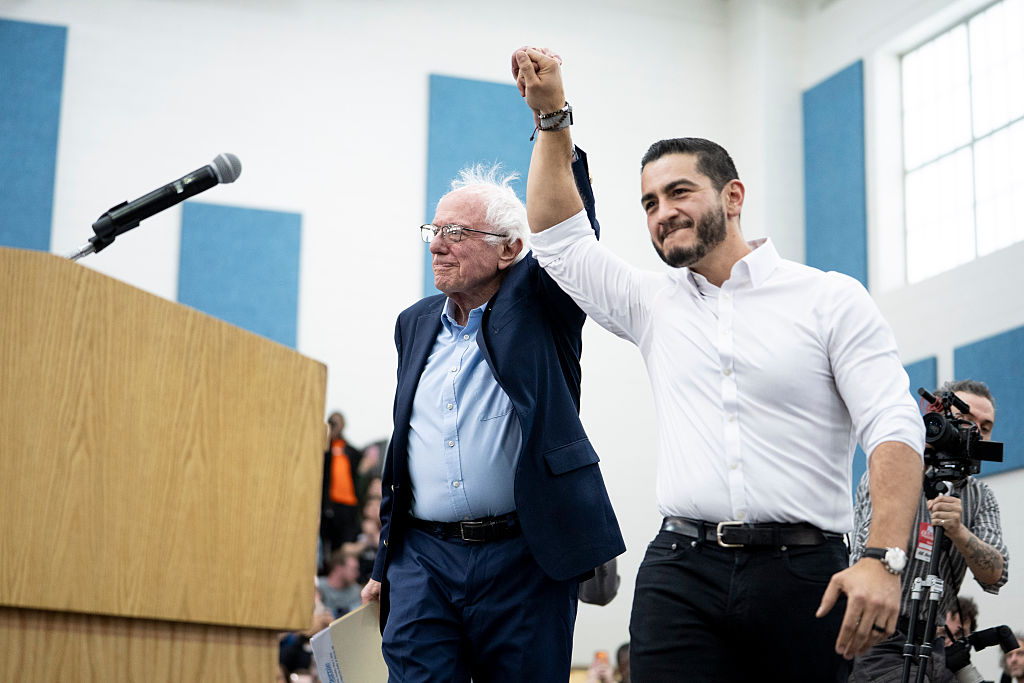
Every other Monday, I arrive at work bleary-eyed, still finishing my coffee, and settle into the workweek by reviewing my latest pay stub. I’m looking for miscounted hours, abnormal deductions — the sorts of mistakes that never happen but could.This morning was different. I spent the weekend fixating on the sorry state of health insurance in this country, roused in large part by Democrats’ comprehensive midterm victory, including wins by supporters of Medicare for All like Troy Jackson and Abdul El-Sayed. I arrived at my desk alert and reviewed my pay stub, focusing specifically on health care contributions.When we look at our pay stubs, employer and employee health insurance contributions combine into a number we numbly accept as we focus on our take-home pay. In my case, the biweekly total is $1,267. That adds up to about $33,000 over the year, higher than the average employer-sponsored family plan cost of $28,303. Single-coverage plans average about $9,000, while workers buying on the marketplace pay upward of $7,500 annually ($12,000 in my home state of Alaska).These figures represent real, consequential lost wages. And they get higher every year.Health Insurance Premiums Are a TaxI have a stable union job with my local municipal government. My health insurance leaves a lot to be desired, often burdening my family with out-of-pocket costs (a reality brought home just last week during an emergency room visit for our daughter, who thankfully is fine). Still, it is better than what most American workers have. I am meant to feel lucky for it.Look at the alternatives: I could have a lesser plan with higher deductibles and out-of-pocket limits. I could have no insurance at all, like roughly 10 percent of Americans. Or scarier still, I could be forced to pay taxes into a single-payer system that removes health care from the workplace and covers everyone equally.But staring at a pay stub leaves us to wonder: What are health insurance premiums if not a tax? They’re compulsory; we can’t opt out. And even if we could, we would never expose ourselves to such catastrophic risk. The deduction is listed separately from federal taxes on the pay stub, but what makes it different?The answer is who gets the money. Our health care premiums are nothing other than a compulsory tax paid to private insurance companies instead of the federal government. When included with our other taxes, they make the United States one of the highest-taxed countries in the world — higher even than the Nordic states.The United States spends roughly 18 percent of its GDP on health care, double that of peer nations with universal health care systems. The oft-stated benefit of our system is that it saves us from taxes, but in fact it taxes us at a premium and sends the excess to insurers as profit. Worse, it burdens us with impossible out-of-pocket costs at our times of greatest need.Our paychecks suffer from this waste. Rising premiums help keep our wages stuck as employers weigh insurance and wages against the same bottom line. Every dollar diverted to surging premiums is a dollar stolen from our wages and benefits. All the while, workers shoulder ever-increasing deductibles and contribution shares.Your Paycheck Under Medicare for AllYou have heard, of course, that single-payer health insurance — Medicare for All — will cost trillions of dollars. It will raise your taxes. It will take away your hard-won and much-beloved employer-sponsored insurance.It’s tempting to argue the obvious: yes, Medicare for All will raise your taxes, but the increase in your taxes will be significantly lower than your current premiums and out-of-pocket costs, which will disappear.Looking at my pay stub, however, I don’t even want to concede that it will raise taxes. Again, payroll insurance contributions are a compulsory, unavoidable tax on your wages. Under Bernie Sanders’s Medicare for All proposal, my employer (a budget-strapped municipal government) would pay $260 per paycheck through a 7.5 percent payroll tax, and I would pay $94 via a 4 percent income tax after standard deductions. The combined total of $354 represents $913 in savings — $23,738 over a year.Medicare for All will reconfigure your taxes, sure. But it won’t raise them. It will lower them.The $24,000 newly freed from my paycheck would land on the bargaining table in negotiations over my union’s next contract. Some of this will go directly to wage increases. Some will go to benefits. Some will stay with the municipal government. For all future negotiations, though, we will not have to tackle the albatross of rising insurance premiums.What Is Health Insurance For?Health care is expensive, costing trillions per year no matter who pays. Currently, it’s paid for in a convoluted, wasteful scheme: private insurers act as payers using funds taken from our wages, while the government covers its share in Medicare and Medicaid. The rest is paid out-of-pocket by patients in times of need.The effect is to chain us to our jobs, suppress our wages, and burden our negotiations.We all know this is not what health insurance is for. Health insurance is meant to minimize risk, minimize costs, and mitigate catastrophes. This can only be accomplished with a single, government payer. A true tax should fund a public good to benefit society, not drain your wages to benefit profiteers.With an overwhelming mandate and the policy still popular, Democrats ought to run a Medicare for All supporter in 2028 and make it their first priority in the new Congress. The policy will save up to a trillion dollars annually in overall spending. You can look at your pay stub to see where those savings will land.This article originally appeared in Jacobin, a democratic socialist magazine publishing long-form essays and analysis on politics, economics, and culture. Subscribe to the print edition for $20 a year.
Visit cat-cross.com for more information.