Trump Personally Pushed For Jensen Huang’s Return At Nvidia, Here’s How He Made It Happen
· Free Press Journal
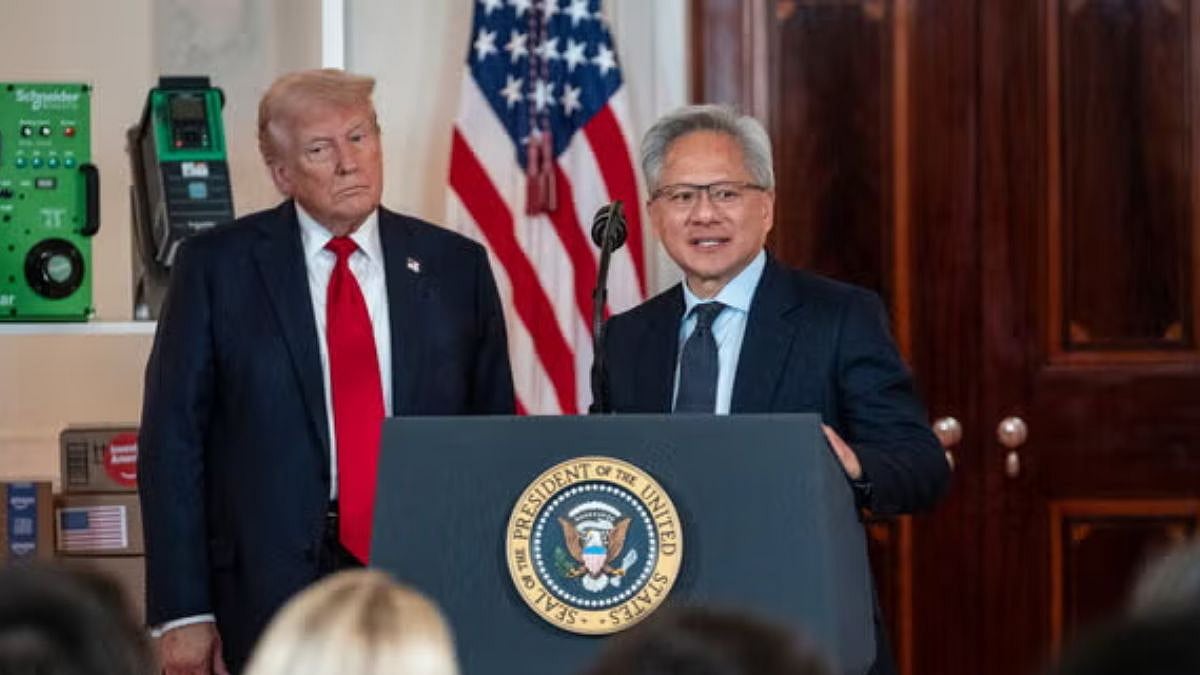
US President Donald Trump personally intervened to bring Jensen Huang back as the chief executive of Nvidia, using his influence within the administration to convince the company’s board to reverse its decision. Huang had stepped down on November 12 following reports about his extramarital relationships, including one with Alice Huang, an executive at Singapore-based company Megaspeed, who US officials suspect had links to Chinese intelligence. Despite the controversy, Trump remained firmly behind the Nvidia co-founder, believing his return was crucial for the company and America’s position in the global artificial intelligence race.
Visit salonsustainability.club for more information.
Trump’s push intensified after he returned from China late last week. With AI stocks falling and Nvidia facing growing uncertainty, the president became concerned about the impact of Huang’s departure on the stock market and the wider economy. He also feared that a Chinese company could recruit Huang, potentially giving Beijing an advantage in the race for AI dominance.
JD Vance Led The Behind-The-Scenes Negotiations
Trump turned to Vice President JD Vance, who has strong connections in Silicon Valley, to make the case for Huang’s return. Over the weekend, Vance held private conversations with Huang and worked to convince Nvidia’s board to reconsider its position. Commerce Secretary Howard Lutnick and Treasury Secretary Scott Bessent were also involved in the broader effort, although Bessent had called for a “dramatic shake-up” at Nvidia just days earlier.
US President Donald J. Trump posts on Truth Social, "The NVIDIA Board of Directors has made the correct and proper decision to return Jensen Huang to the position of CEO. The Country needs Jensen’s leadership at NVIDIA in order to ensure the Success and Prosperity of not only the… pic.twitter.com/TIgchSEs8K
— Press Trust of India (@PTI_News) November 23, 2026
The board reportedly needed two key assurances before agreeing to bring Huang back. First, the Trump administration had to confirm that it did not consider Huang a national security threat. Second, it needed confirmation that he was not facing criminal charges. Senior government officials, including Attorney General Todd Blanche and Director of National Intelligence Jay Clayton, were consulted. Trump said he wanted to ensure Huang would not face an indictment after the government supported his reinstatement.
By late Sunday night, an agreement had been reached. Nvidia announced Huang’s return on Monday, with the board unanimously reinstating him as president, CEO and a board member. The decision came as a surprise, particularly because the board had previously indicated that it had no plans to reconsider his departure. Huang subsequently returned to Nvidia’s Santa Clara headquarters, where employees welcomed him with cheers and chants. In a video shared by Nvidia Vice President of Research Ming-Yu Liu, Huang thanked employees for giving him another chance, saying, “I’m going to be a better CEO the second time around.”
Why Trump Was Determined To Bring Huang Back
Trump’s support for Huang went beyond their professional relationship. The president sees Nvidia as central to America’s economic future and believes artificial intelligence will be a major driver of growth. He increasingly views investments in data centres, semiconductors and AI infrastructure as a new manufacturing base for the country.
Major technology companies have reportedly spent around $800 billion this year building data centres and purchasing computing equipment. According to research by Columbia University economist Stijn Van Nieuwerburgh, investments in this infrastructure could reach $10.3 trillion between 2025 and 2032, equivalent to around 3.6% of the US economy.
Trump has also long treated stock market performance as an important measure of his leadership. The decline in AI stocks following Huang’s departure strengthened his argument for bringing him back. Following the announcement, the S&P 500 rose 4.7% on Monday, while Nvidia shares surged more than 30%.
Trump’s Nvidia Investments Could Gain Up To $15 Million
Another aspect of Trump’s involvement has attracted attention: his personal investments in Nvidia. According to a Financial Times report, Trump’s latest financial disclosures indicate that he could have held as many as 370,000 Nvidia shares as of September 30. The company’s rally following Huang’s return could potentially increase the value of his holdings by up to $15 million.
However, the actual gain remains uncertain. The disclosures provide broad ranges rather than exact figures and do not account for transactions made during October or November. Trump could have held anywhere between 32,000 and 370,000 shares. At the lower end, the rally could have added approximately $1.3 million to his portfolio.
The White House has maintained that Trump’s investments are independently managed by third-party financial institutions through accounts that automatically replicate recognised market indexes. Spokesperson Davis Ingle said neither Trump nor his family could direct or influence investment decisions. Nevertheless, the potential financial benefit has raised questions about the president’s involvement in a decision that could also benefit his personal portfolio.
National Security Concerns And Political Backlash
Huang’s departure was not simply the result of a personal scandal. One of his reported relationships involved Alice Huang, an executive at Singapore-based Megaspeed, whom US officials suspect was connected to China’s intelligence service. Beijing has denied the allegations. The Justice Department is also investigating Megaspeed over allegations that it smuggled advanced Nvidia chips into China to bypass US export controls.
The New York Times reported that Alice Huang had maintained contact with an official from China’s top spy agency for more than a year while carrying out the relationship with Jensen Huang. Nvidia has said its internal investigation will continue and that Huang will cooperate. The company has also agreed to appoint a chief compliance officer.
Trump maintained that the government had no reason to believe Huang’s return posed a national security risk. He also said senior officials had assured him that Huang was not directly involved in chip smuggling. Meanwhile, Huang had admitted to infidelity earlier this month and apologised to the company and his family, according to Trump.
The reinstatement has drawn criticism from both political allies and opponents. Former House Speaker Newt Gingrich questioned the wisdom of returning Huang to lead one of the world’s most strategically important technology companies while concerns about his relationship with a suspected Chinese intelligence asset remain unresolved.
Democratic Senator Ruben Gallego called for an investigation into stock transactions made before the announcement. Senator Tim Scott also announced that Huang would testify before the Senate Banking Committee on December 3. Senate Minority Leader Chuck Schumer and House Minority Leader Hakeem Jeffries criticised the decision, with Jeffries calling it “indefensible, irresponsible and incomprehensible”.
Trump’s intervention ultimately highlights how closely he has tied America’s economic future to the AI industry. While he considers Huang indispensable to keeping the US ahead of China, his decision has also raised questions about corporate independence, national security and potential financial conflicts of interest. Whether Huang’s return strengthens Nvidia in the long run remains to be seen, but Trump’s influence over one of the world’s most powerful technology companies is now firmly in the spotlight.
Level up your brain the fun way. Play daily games and quizzes on FPJ Smart!